
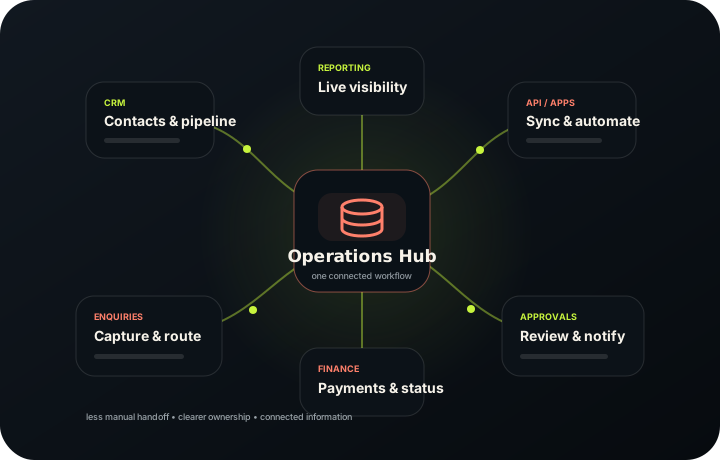
The problemImportant information is spread across too many tools
CONNECTED OPERATIONS
Stop running important work across disconnected tools.
When information lives in too many places, work slows down. We connect the moving parts so your team can operate with less friction and more visibility.
02WHY THIS MATTERS
When the tools do not talk to each other, the team carries the gap.
Manual handoffs, duplicated data and scattered spreadsheets create friction that grows with the business. We map the real workflow first, then build the smallest reliable system that connects the people, information and actions involved.
What we buildAdministrative dashboards
The resultFewer disconnected manual steps
WHAT WE SOLVE
From friction to a clearer system.
We scope the work around the actual problem, the people using the system and the outcome the solution needs to support.
Problems we help solve
- Important information is spread across too many tools
- Teams repeat manual steps that could be structured
- Approvals and handoffs are difficult to track
- Client or operational data is duplicated across systems
- Reporting requires too much manual effort
What this can include
- Administrative dashboards
- CMS and editorial systems
- Enquiry and client management workflows
- Approval and review systems
- Booking and payment integrations
- API and third-party integrations
- Operational reporting interfaces
- Role-based access controls
- Notification and status workflows
- Data capture and structured internal processes
Expected outcomes
- Fewer disconnected manual steps
- Clearer ownership and status across workflows
- More reliable operational data
- Reduced duplication and avoidable admin work
- A system that reflects how your team actually operates
ENGAGEMENT OPTIONS
Choose the level of support the work requires.
The final scope depends on the existing environment, access, requirements and the outcome the engagement needs to support.
Workflow System
A purpose-built internal workflow around a defined operational process.
Dashboard & Admin Tools
Interfaces for managing content, records, approvals or operational status.
Integration Project
Connect existing tools or services where stable APIs and access are available.
HOW WE APPROACH IT
A focused path from requirement to working system.
We keep the process visible, testable and tied to the approved scope rather than adding complexity for its own sake.
Map
Document the current workflow, users, decisions and failure points.
Define
Agree the system boundary, roles, data and integrations.
Build
Implement the operational interface and required connections.
Validate
Test permissions, edge cases, reporting and the real user flow before rollout.
FAQ
Questions before we start.
The right solution depends on the real requirement. These answers explain the boundaries of the service before scoping begins.
Do we need to replace all our existing tools?
Not necessarily. We first determine what should be kept, connected or replaced.
Can you integrate third-party platforms?
Where the platform provides suitable APIs, permissions and documentation, integrations can be scoped.
Can different staff have different access?
Yes. Role-based access can be designed where the project requires it.
START A PROJECT
Discuss a business system ↗Have a process that has become too manual or fragmented?
Show us how the work happens today. We can help identify where a focused system or integration would create the most value.